Posts

THE 'TIMES SIX' PRINCIPLE FOR TENNIS PARENTS

Image
AS A COACH THE LANGUAGE I use is important. Something said the wrong way on the court can harm the player, while compliments tend to have a more positive effect. I use the 'TIMES SIX principle' when talking to players on-court or whenever they have just finished their match.  The 'TIMES SIX principle' means that anything you, say either as a parent or as a coach, is magnified by six times in the head of the player. It is therefore always important to filter your comments through the TIMES SIX 'filter' and imagine how your comment will be perceived if multiplied six times. An example could be if, as a coach or parent you remarked that the player had missed many first serves in the match (which could be completely correct), and told the player this soon after their match. The result of that comment could be disastrous (remember the TIMES SIX Principle) because the player could take the comment as a personal attack on them and their ab...
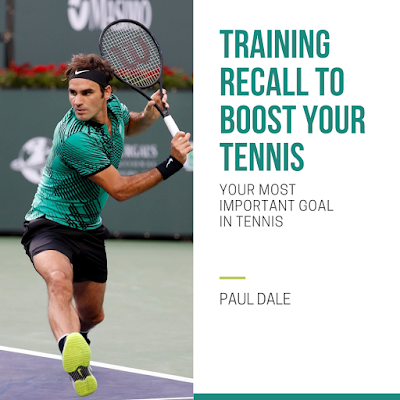
TRAINING RECALL IN YOUR PLAYERS

Image
I’m not a fan of using repetition to practice when training players. I use repetition drills very rarely. Repetition drills are when a player has to hit many balls one after the other, either from a basket feed or with someone at the other end giving you the same ball. Repetition drills contain very little that is similar to match-play. I understand it looks good to people watching the lesson from a distance outside the court and on Instagram posts but repetition drills offer very little to players wanting to develop a new technique or pattern for their next match. Often coaches feel that they have done their job by showing the student the new technique and then drilling it many times through repetition. They believe the transfer of information (the new technique being taught) from the practice court to match court should happen automatically and is the players' responsibility. This is false. It’s the coach’s job to introduce the new technique AND to creat...

OPEN & CLOSED STANCE GROUND-STROKES (Thai/Eng)

Image
Let's be clear from the start, you need both options! Open and closed stances have advantages and disadvantages, and you need to adopt both stances during a match if you want to play tennis at a high level.  Here’s when it’s best to hit an open stance ground stroke and why… แน่นอนตั้งแต่เริ่ม — คุณจำเป็นต้องใช้ทั้งสองท่า! ท่าเปิด (Open Stance) และท่าปิด (Closed Stance) ต่างก็มีข้อดีและข้อเสียของตัวเอง และหากคุณต้องการเล่นเทนนิสในระดับสูง คุณต้องสามารถใช้ทั้งสองท่านี้ได้ระหว่างการแข่งขัน ต่อไปนี้คือสถานการณ์ที่เหมาะกับการใช้ท่า  Open Stance  และเหตุผลที่ควรใช้: OPEN STANCE 1.  Better for higher balls because you can generate more power and maintain balance. With a higher ball , generating power on the shot is sometimes tricky. Adopting an Open Stance allows you to achieve back-swing and follow-through by utilising upper-body rotation.  2.   It c an help you disguise your intentions on certain balls, such as a mid-court put-away. You want to ...

THE LONG LAST STEP

Image
With the US Open starting this week, there is plenty to learn while watching the matches, which we can use to improve our game. One technique you will see often over the next two weeks is ' THE LONG LAST STEP .' The top players use this technique to help with coordination, timing, and balance as they move around the court to hit the ball. To understand The Long Last Step, we need to break the whole topic of movement into 3 parts. All 3 parts relate to each other, and The Long Last Step is an integral element of them. #1 MOMENTUM When you run to hit a ground stroke, momentum is created. As you reach the ball, that momentum has to be disciplined before you attempt to hit the ball; otherwise, you will lose balance during the stroke. Any balance problems during the execution of a stroke will mean a lack of consistency. To control your body's momentum, we create a last step that is longer than the other steps used to reach the ball. By stepping long in this way, we hav...

4 ESSENTIALS FOR THE DEVELOPING PLAYER

Image
The top players have few weaknesses in their games, and, as I have said many times, to reach the top, you must work to eliminate any weaknesses you may have. Weaknesses in your game eat away at your confidence and are usually worse when you are under the most pressure, at the most unwelcome times. The big picture when developing players for the future should also include working on strengths.  Young players should be well-rounded and be equally skilled in dealing with defensive and offensive situations. Here are my 4 top choices when developing the offensive game of a young player: #1 OWN A GREAT SERVE Owning a great serve is a massive asset in tennis. If you can hold serve or even put your opponent on the defensive at the start of each point you will win a large percentage of your service games. HERE'S WHAT TO DO... https://thetenniswhisperer.blogspot.com/2015/01/the-two-must-have-service-techniques.html #2 HAVE  A STRONG CROSS-COURT GAME ...

INVINCIBILITY LIES IN THE DEFENSE: The Sun Tzu Method for Tennis Match Preparation

Image
Invincibility Lies in Defence: The Sun Tzu Method for Tennis Match Preparation By Paul Dale | The 3AM Method The Three Words That Define Elite Tennis Performance Preparation, preparation, and preparation. This isn't just repetition for emphasis—it's the foundation of breakthrough tennis performance. Yet the majority of players prepare incorrectly, focusing solely on offensive power while neglecting the defensive skills that create championship-level resilience. The ancient Chinese military strategist Sun Tzu understood something that modern tennis coaches are only beginning to grasp: "Invincibility lies in the defence; the possibility of victory in the attack." Tennis is warfare without the dire consequences after a defeat Why Traditional Tennis Preparation Fails Under Pressure Most players enter matches having practiced their forehand power, serve speed, and aggressive patterns. They've meticulously built their offensive arsenal. But when pressure mounts and...