Posts

THE TASK V'S EGO MOTIVATED PLAYER

Image
  It's important to understand what motivates each player, and also what demotivates them   Learning what motivates each player to train hard and compete strongly in competition is critically important to a coach. Understanding what dominates a player’s mindset allows us to “push the right buttons” when needed. I like to assess players based on their motivation for playing in the first place. I look at two forms of stimulation, Task or Ego motivation; their motivation to train and compete will be driven by either their willingness to work hard, Task, or their focus on winning and rewards, Ego. Task-motivated players are the type of players who thrive on working hard towards a goal.   They see a clear link between working hard off-court and being rewarded with improved results on-court. Coaches enjoy working with players who are Task motivated because they have a great work ethic and respond well to instructions.  Most coaches prefer coaching Task motivated ...

CAN YOU PLAY YOUR BEST TENNIS AT 3AM?

Image
Why Tournament Champions Thrive While Practice Players Crumble (And the 3AM Theory That Builds Instant Adaptability) By Paul Dale |  www.3amtennis.com Several years ago, I was on a practice court with Tamarine Tanasugarn at 7am after a long international flight. While everyone else struggled to adjust to unfamiliar conditions, Tamarine was striking the ball as cleanly as ever. Her timing was perfect from the first ball until the last. Here's what most coaches need to understand: Every tournament breakdown, every first-round loss by a superior player, every collapse when conditions change stems from training methods that prioritise comfort over competitive reality. We're approaching tournament preparation completely wrong. Players don't need more perfect practice—they need systematic exposure to the unpredictability that defines competitive tennis. Your next breakthrough doesn't come from perfecting strokes in ideal conditions. It comes from mastering what I call the...

WHAT IS THE PURPOSE OF GRIPS?

Image
A few decades ago, coaches made a big deal about the grips a player used.   The first step in any lesson usually involves learning the correct grip.   Back then the grip was god. The grip's primary function for beginners and intermediate players is to provide strength and stability between the hand and racquet. For advanced players, the grip's primary job is to allow the racquet head to perform its function. This article addresses eliminating contamination that can occur when a faulty grip prevents the racquet head from performing its intended function. If a certain forehand grip doesn’t allow the racquet-head to hit a high-bouncing ball cleanly , that player has a weakness that can be exploited by their opponent. He/she must find a new grip position or a technique that helps them better adapt to high forehand balls. Often, tactics that help you beat an opponent are based on the opponent's inferior grips, which fail to adapt to speed and height. Extreme west...

THE SERVE: TO SNAP OR PRONATE, WHICH IS BEST?

Image
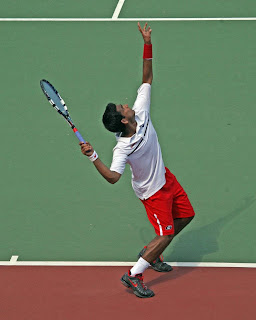
 To Snap or Pronate, Which is Best?  There are two theories on how to hit a serve.   Some people believe that “Snapping” the wrist is the best way, and others say that “Pronating” is the best method of serving.  The difference between the two options is difficult to detect visually. When you snap the wrist to execute the serve, the racquet-head tends to finish with the tip leading and the right and left edges going through contact almost symmetrically. When you pronate to hit the serve, the left edge (in the case of a right-hander) tends to lead the racquet through the ball. Both styles achieve the same result when executed correctly. Both Snapping and Pronating, when done correctly, promote a wrist that dominates the arm during the serve. Whenever the arm dominates the wrist during the serve the result will be a serve lacking feel for your target and reduced racquet-head speed. A dominant wrist that Snaps or Pronates will give the serve the timing,...

TRAINING X-FACTOR IN 3 STEPS

Image
I recently worked with a group of strong ITF-level juniors. Each player had a solid game; the task for me was to take these accomplished juniors and prepare them for the next tournament. Because ground strokes are essential to a player’s competitive success, I focused on adding to their existing ground stroke games.   Many players at this level have good ground strokes but lack that X-factor separating promising juniors from juniors who transition successfully into the professional ranks. I wanted to remove them from their "consistent, safety first" mindset and add some "X-Factor" to their games. During the week of training, I brought 3 different teaching theories together. I created a much stronger, more effective game that would continue to develop far into the future. The 3 Theories I worked with them on were:      1.  THE 7 TARGET ZONES: Knowing where to hit the Ball and Why There are 7 target zones on the court. They are… (1) ...